
Review published 24th November 2026
Watch the official trailer.
The Story
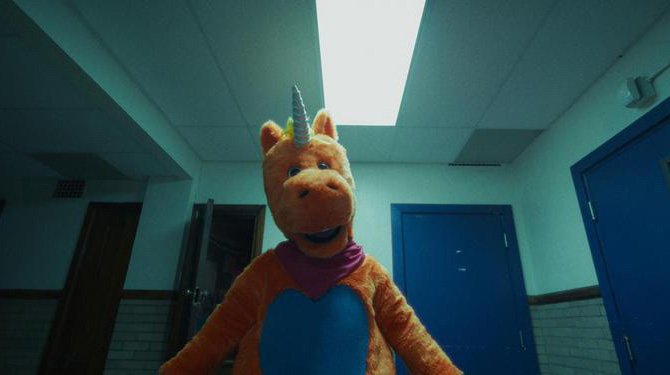
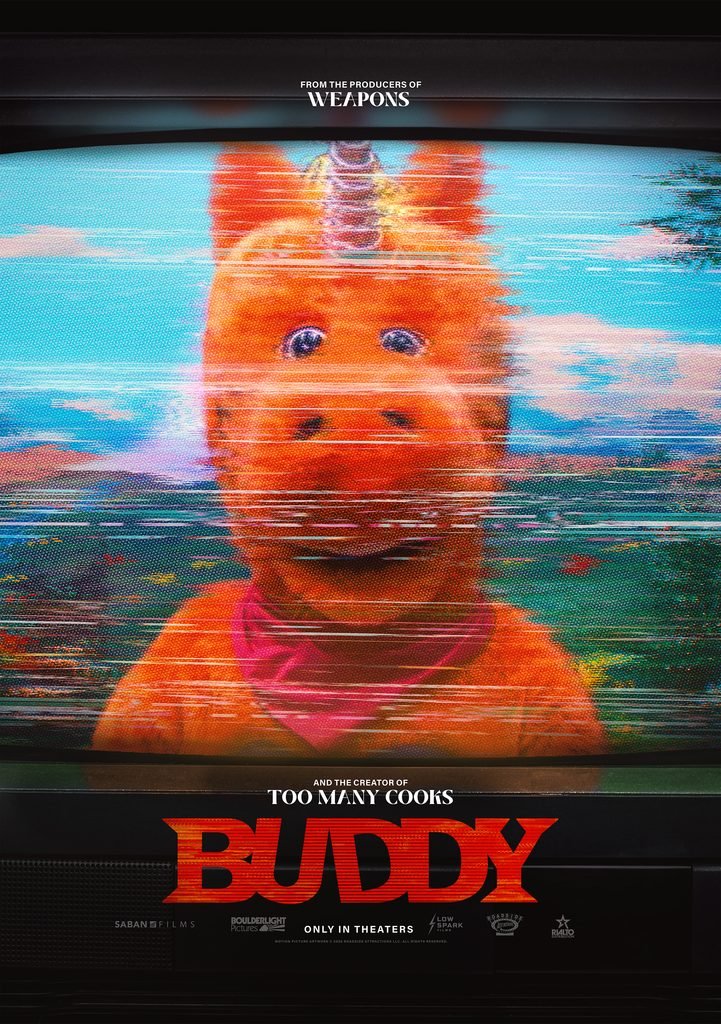
Set in 1999, Buddy opens by immersing audiences in an episode of the smash-hit children’s television series Buddy, presented in a glorious 4:3 aspect ratio and complete with VHS-style picture quality. Buddy (Keegan-Michael Key), a cheerful magical unicorn, spends his days teaching valuable life lessons alongside his friends Betty Bunny (Jimmica Collins), Nurse Nancy (Phuong Kubacki), Mailman Miles (Bennie Taylor), and a collection of neighbourhood children. Whether the lesson involves courage, friendship, or learning to believe in yourself, Buddy appears to be the perfect children’s program.
However, during an episode centred around courage and taking chances, one of the child actors mysteriously disappears. As evidence begins to emerge and suspicions start growing among those involved with the production, attention slowly shifts towards Buddy himself. What initially seems impossible gradually becomes increasingly difficult to ignore. Somehow, the beloved unicorn adored by generations of children may also be a ruthless killer. Soon, a world once filled with laughter, songs, and positive messages transforms into a place of bloodshed, paranoia, and death. The question quickly becomes whether anyone can survive Buddy’s increasingly violent behaviour, or if the lovable unicorn will continue his deadly rampage.
A Love Letter To Children’s Television
Directed by Casper Kelly, whose previous work includes Too Many Cooks (2014), Night of the Living Doo (2001), Adult Swim Yule Log (2022), and Adult Swim Yule Log 2: Branchin’ Out (2024), Buddy immediately demonstrates the filmmaker’s ability to blend bizarre comedy with horror. One thing becomes clear almost immediately: This film absolutely nails the look and feel of a late-1990s children’s television show. From the aspect ratio and VHS presentation to the colourful sets, cheerful songs, energetic performances, and educational themes, Buddy feels completely authentic. Had somebody shown me the opening ten minutes and claimed it was an actual children’s program from 1999; I honestly would have believed them. The attention to detail is remarkable. It’s this authenticity that makes the horror elements work as well as they do later on.
Buddy Is Ridiculous And That’s The Point
Despite being positioned as the film’s primary horror figure, Buddy is rarely frightening. Instead, he’s absurd. And that’s exactly why the character works. Watching a colourful children’s mascot wander through increasingly violent situations while delivering upbeat messages and bizarre one-liners creates a wonderfully strange contrast. Buddy often feels more shocking, bizarre, and darkly amusing than genuinely scary. Keegan-Michael Key deserves considerable credit here. His vocal performance gives Buddy an infectious energy, helping transform what could have easily become a one-note gimmick into one of the year’s most memorable horror characters. This certainly isn’t one of Key’s greatest performances, but it is one of his most unexpected. Without the voice work, I don’t think Buddy would be nearly as successful.
Funny More Than Frightening
Horror fans expecting a terrifying experience should probably adjust their expectations. While the film features murders, bloodshed, and a surprisingly high body count, Buddy is ultimately more interested in comedy and absurdity than traditional scares. The humour largely comes from the sheer ridiculousness of the premise. Many of the kills are so over-the-top that they become unintentionally hilarious, while several puppet-related deaths also add to the film’s bizarre charm. Buddy himself frequently contributes to the laughs through his behaviour, dialogue, and complete lack of self-awareness. The film definitely embraces the idea that audiences are laughing with it rather than screaming at it.
The Mystery Keeps Things Interesting
One aspect I appreciated was the film’s willingness to take unexpected turns. What initially appears to be a relatively straightforward horror-comedy gradually introduces additional layers of mystery, including a storyline involving a seemingly unrelated family. At first, I wasn’t entirely sure how these new developments connected to Buddy. Surprisingly, that uncertainty worked. Rather than frustrating me, it encouraged me to stay engaged and continue piecing things together. The mystery isn’t particularly complex, but it provides enough intrigue to stop the film from becoming repetitive.
A Strong Start That Loses Momentum
Unfortunately, Buddy struggles once it reaches its final act. While the opening and middle portions remain highly entertaining, the film gradually begins to lose focus as it approaches its conclusion. The pacing noticeably slows. Several mysteries fail to receive particularly satisfying answers. And the finale never quite delivers the explosive payoff that the earlier build-up suggests. It’s not a bad ending by any means. Rather, it feels like a film filled with creative ideas that isn’t entirely sure how to bring them together. The final showdown works well enough, but it lacks the impact needed to elevate the film into something truly special.
Strong Production Design And Practical Effects
Another major strength is the practical craftsmanship on display. The costumes, puppets, set design, and visual presentation all feel incredibly authentic. Buddy and his friends genuinely look like characters who could have stepped straight out of a real children’s television series. The puppet work is particularly impressive and frequently helps sell the illusion that this strange world truly exists. Combined with the colourful sets and nostalgic presentation style, the production design becomes one of the film’s strongest qualities.
Overall
Buddy is one of the year’s most unusual horror-comedies and succeeds largely because it fully commits to its bizarre premise. The recreation of a 1990s children’s television show is incredibly convincing, the practical effects and puppetry are impressive, and Keegan-Michael Key’s voice work helps transform Buddy into a genuinely memorable character. The film takes several unexpected narrative turns and often feels refreshingly different from many recent horror releases. However, a lackluster third act and a finale that never quite reaches the heights promised by the setup prevent the film from becoming truly great. Most importantly, don’t expect something genuinely terrifying. This is far more interested in being weird, colourful, shocking, and absurd than it is in delivering nightmares. If the idea of a Barney-style children’s mascot becoming a homicidal horror icon sounds appealing, Buddy is absolutely worth checking out. And while its magic eventually begins to fade, the journey remains entertaining enough to make it one of the more memorable genre offerings of the year.
Buddy (2026) will be Available in Australian Cinemas from November 26th thanks to Rialto Distribution!
About the Reviewer
Peter Walkden
Film writer and curator with a deep passion for cinema, genre filmmaking, and physical media. Exploring new releases, cult favourites, and overlooked films, with a strong focus on atmosphere, storytelling, and the theatrical experience.
Connect
Instagram: https://www.instagram.com/walkdenentertainment/
Letterboxd: https://letterboxd.com/Peter_Walkden/
Website: https://walkdenentertainment.com/
More links and updates: https://linktr.ee/PeterWalkden